Constraining to Constrain or Constraining to Afford?

Constraining to Constrain or Constraining to Afford?
The Proper use of Constraints
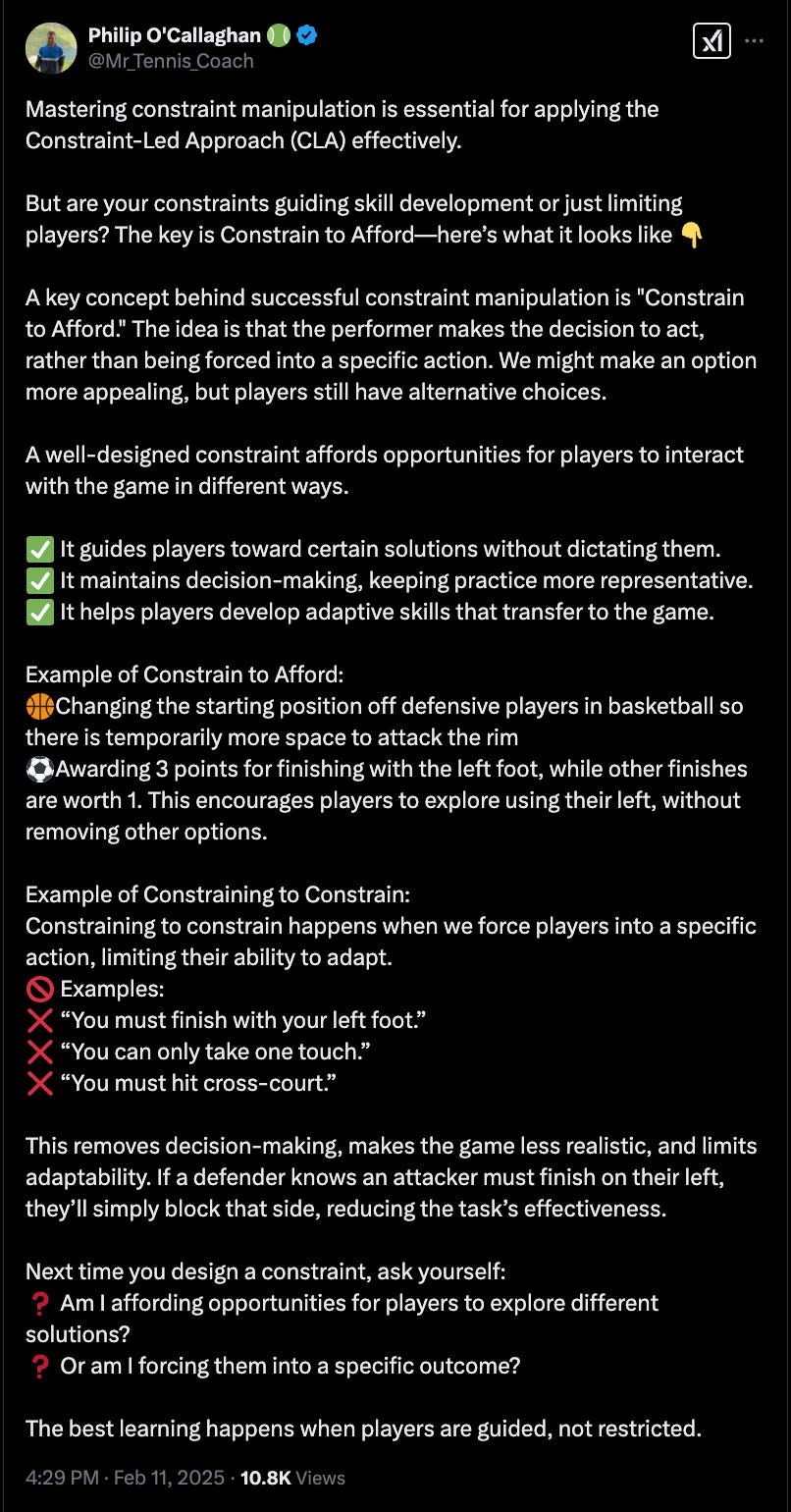
What Philip O’Callaghan is saying here is quite interesting (he has a lot of thought provoking content, I’d recommend checking him out). I very much agree with him that “forcing” athletes into a particular solution is rarely the best way to go. However, this conversation needs a little more nuance than can be captured on X.
Constraints always afford. That is their nature, they shape the field of available actions constantly and dynamically. That is part and parcel of the scientific and philosophical theory - affordances are shaped by constraints - task, individual, and environmental. Traditional coaching often over-constrains or constraints in a way that athletes are not picking up on affordances that appear in live competition.
What Mr. O’Callaghan is doing here is making a delineation:
“constraining to constrain” (basically, just making up constraints without understanding of purpose, and often overly restricting the athlete’s actions or overly restricting it in a way that makes the intended solution too obvious, or forces the athlete to use a particular solution)
vs.
carefully planning constraints to guide the player's actions without giving them the answer to the problem - “constraining to afford”.
This captures an important aspect of the discussion around how to engage with the ecological approach to skill development.
But I think this dichotomization is perilous and actually might further confuse coaches.
“Non-Linear”: Constraints shape possible solutions, they do not “cause”
“You must finish only with your left foot” - what this sounds like it is doing is forcing a player into a very narrow solution. They have to do things a certain way! Oh no! We’re back into traditional coaching of the one correct technique.
Except, of course, they could perhaps explore an area of the game that is not finishing. After all, nobody said they had to do everything with their left foot…
Maybe they’ll end up dummying the ball and letting a teammate play it, maybe they’ll drop into a support role behind the play, maybe they’ll trap the ball with their right foot in a way that opens up opportunities to use the left, but then pass with the outside of the right foot, something they never would have done had they had the opportunity to try and score with the right. Saying they had to finish with their left foot did not prescribe a solution, it took away a solution. It’s a relatively strong constraint, but there’s undoubtedly situations in which stronger constraints are necessary.
(I’m not saying the art of coaching consists in tying players feet/legs behind their back)
Or….
“You must hit cross court!” - how exactly does this remove decision making?
Well, it doesn’t. It removes some decisions. All constraints close off a portion of the solution space. That’s literally what they do - they constrain. All constraints remove a portion of potential decisions-to-be-made. Some constraints (or combinations of constraints) go too far and imprison - they close off so many solutions that they only leave one solution to be used, or they degrade the situation so much that the problem to solve is below the ability level of the player.
But by closing off part of the solution space we, in theory, open up other parts of the solution space to be explored. This is what ‘education of attention’ is referring to.
If I am a tennis player who is extremely reliant on and attracted to using powerful, aggressive, groundstroke play from the baseline to win points, what does constraining me to only hitting cross court do?
Well, for one, there’s less baseline to work with. I’ll be less likely to hit a passing shot off a pure baseline ground stroke, like I am used to doing.
So, you could see that as “restricting” me or as “giving the solution.” After all, you are making me hit it cross-court!
Or you could see it as affording me the opportunity for finding another way to solve problems. Maybe I could, perhaps, explore hitting a drop shot, or using some spin on my shots rather than pure power?
Intensely competitive athletes don’t just change what works for them willy-nilly because coach gives them extra stickers or fake practice points for doing something new and creative - sometimes a shove is more useful than a nudge.
Keeping non-linear causality in the back of our minds suggests that although we may have a strong prediction regarding outcomes, we don’t know what certain constraints will afford.
Only scoring with the left foot may overly constrain a player who is only attempting to score goals in an already constrained drill, but might educate a different player's attention to aspects of the game they rarely explore.
Constraints are not formal causes, they are conditions that shape what is possible. Too much constraint and you aggressively narrow the solution space to the point where athletes act predictably and non-creatively. Not enough constraint and athletes default to less-functional aspects of the solution space that serve as attractors for them.
Perhaps this was not a good example of what Mr. O’Callaghan was trying to express, as often times interactions on X are incomplete. He certainly knows more about tennis than I, and I do think the spirit of what he was saying matters more than the immediate examples.
Why, not what
The constraints-led approach is not about randomly making rules just for the sake of making rules. Constraints must be goal oriented and contextually sensitive - perhaps restricting a beginner to only cross court shots does not make sense, but may be useful for a more advanced player. Of course, the verbal instruction that accompanies the constraint may make all the difference.
Restricting to only cross court shots because hitting cross court is a “fundamental” skill and everyone needs to “drill” that skill ‘til they get it right? ❌
Restricting to only cross court shots because a player continues to neglect opportunities in matches to use a little more finesse, rather than power? Because they actually are quite good at drop shots and slices, but are a little stuck to their solution of using power and top spin, and they might end up discovering another layer to their game? Restricting the ability to win with groundstrokes and power by making the space smaller, so other can be explored? ✅
In the ecological approach the question is just as much “why?” as it is “what?”
Right time, right amount
The craft of coaching lies in right time, right amount; restricting to only cross court shot is a strong constraint, and I think it may take a relatively advanced athlete to recognize the opportunities that are afforded to them in that opportunity.
However, it is not “bad”, nor does it “give” them the solution. Like all constraints, it closes off a portion of the solution space and encourages the athlete to “look” elsewhere for a solution - it educates their attention.

(right time, right amount…. all framed by intention)
It is exactly this type of dichotomous thinking - “one right way to do things” - that has gotten a lot of coaching into the mess that it is in now. For the ecological approach to flourish it requires not just a change in the “what” coaches do, but the “why?”
Good athletes don’t just repeat solutions that they’ve memorized in training, and good coaches don’t just memorize solutions they heard about on X.
It’s a mindset shift, not just a change in methodology. After all, if we just try to change the “what” coaches do and ignore affording them the opportunity to gain deep, contextually-sensitive intuitive knowledge of the “why”, are we being very ecological in our approach to coaching coaches? 🤔
As mentioned above, Mr. O’Callaghan very much has a point, in that the reason you are constraining matters and ultimately will change the way you constrain.
If you are constraining to “fundamentals”, you might get yourself into trouble. If you just want the ball to move because “ball movement is good”, you’re trapped in the “one correct technique” mindset.
If you want the ball to move because it constraints players to read their situation quicker and rely on techniques other than brute force…

“Always make three passes” vs. “Hold the ball for no more than 3 seconds”
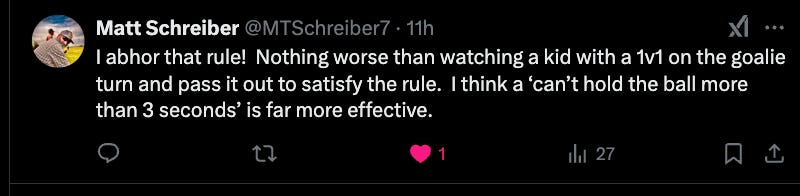
Making players move the ball for the sake of moving the ball gets them to do things because you said so, not because it’s the right thing to do at that moment. Ball movement is often a good thing to have, but only because it creates higher % opportunities to score.
Regardless - beware of the tyranny of the discontinuous mind:
“A symptom that pervades Western thinking is the habit of carving the world into distinct boxes, driven by a desire for clarity and closure. This mental shortcutting can blind us to the smooth gradations connecting what appear to be tidy endpoints, giving us a false sense of certainty about where one thing stops and another begins. To see reality more clearly, we must recognize that much of what we perceive as stark boundaries are merely points along a continuous spectrum.” - me, 2025
Are you thinking in degrees or categories?
God I suck at proofreading. Please forgive me